
Grand Island Past Residents Sources
Who lived at a Grand Island address before is not answered by one Hall County database. Previous residents must be traced from the present Grand Island parcel and its legal description, then backward through recorded instruments, historical maps, census schedules, newspapers, and local directory leads. The source that identifies a grantee is not necessarily the source that places a household at the address. Grand Island address history works best when each record is marked with what it actually shows and when it was created.
| Address-history source | Years it covers | Where held | What it can show |
|---|---|---|---|
| Register of Deeds instruments | Online year cutoff not located | Nebraska Deeds Online, legacy repository, and Hall County office | Recorded instrument data, parties, legal description, and image or plat route |
| Hall County archival series | Approx. 1859–1980, series-specific | History Nebraska RG260 and local custodians | Historic county records, including deeds and assessor series |
| Atlases and Sanborn maps | 1885, 1890, 1904, and 1909 | Hall County, Library of Congress, and local research rooms | Blocks, streets, plats, structures, and historical context |
| Federal census | 1950 is the latest public individual census | NARA and library tools | A household at a dated point, with enumeration geography |
| Permit and city records | Dates vary; no central search portal located | Building Inspection and City Clerk | Existing project, ordinance, or civic records requested by address and date range |
Use the Hall County Register of Deeds route for a Grand Island recorded-ownership trail. Use census and directory material for the Grand Island household layer. Use maps to check the address and structure in its period. The resulting timeline should show disagreement rather than forcing every source into a single claim.
Note: A Grand Island postal address can sit outside the incorporated city, so confirm the parcel jurisdiction before routing a local records request.
Grand Island Deed Index Limits
The Hall County instrument search is the main online route for Grand Island deeds, plats, mortgages, reconveyances, liens, and related real-property documents. Visible search choices include name-style searching, instrument or index number, book and page, legal-description components such as section, township, range, subdivision and block, plus a plat-view control. If a name is common, use the legal description from the parcel record. That description stays more stable than a Grand Island street address across a long house-history search.
The legacy Hall County deeds repository says instruments are available from sequence 76000002 to current. That is an instrument-sequence notice, not a documented beginning year. No official online year cutoff, full export description, or complete pagination instructions were located. Search the labels visible in the form and preserve the instrument number, recording date, document type, grantor, grantee, legal description, book or page, and image status for each useful result.
The legacy repository source view is shown below. It is useful as an access route, but it does not establish that every earlier Hall County document is online.
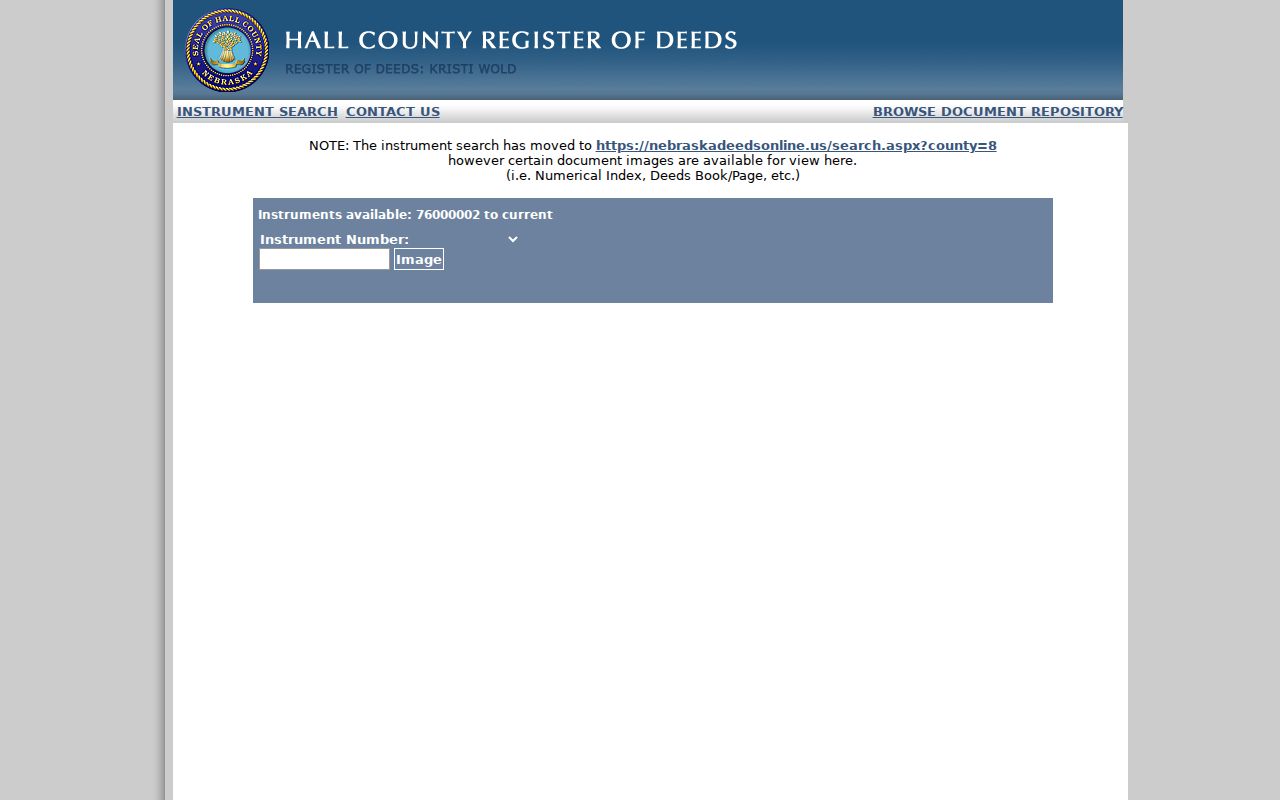
The repository image reinforces the need to distinguish an available instrument sequence from a verified historical coverage year. For older records, the office, microfilm holdings, and archival finding aid remain part of the search.
Trace Grand Island Deed Chains
Begin a Grand Island past-residents search with the current parcel record, then use the deed index to walk backward. A chain of title is the sequence of recorded transfers or interests connected to the same property. It is not a guarantee of clear title. The Hall County Register of Deeds scans recorded instruments and connects to GIS, but the office does not give title opinions. An examiner or abstractor is the appropriate source for a title determination.
- Find the current parcel in the Hall County and Grand Island GIS or Assessor search, then copy the parcel ID, situs, and legal description.
- Search the current holder or legal-description components in the Register of Deeds index and record the purchase instrument.
- Read the prior party from that instrument. Search that party as a grantee to locate the earlier acquisition when the record supports the link.
- Repeat the sequence backward, keeping the instrument number, date, document type, and legal description beside every step.
- When the online route stops, ask the Register of Deeds or an archival custodian about existing microfilm, books, or the relevant Hall County series.
- Grantor
- The person or entity transferring an interest in a recorded instrument.
- Grantee
- The person or entity receiving an interest in that recorded instrument.
- Chain of title
- The recorded sequence of property transfers and related interests. It is research evidence, not a title opinion.
- Legal description
- The lot, block, subdivision, or survey wording that identifies land in official property records. It is often more durable than a street address.
A Register of Deeds FAQ gives the office copy route: copies are listed at $0.20 per page and certified copies at $1.50 per page. It also warns that staff may give an owner name or legal description but not a property-owner mailing address.
The FAQ view below is a good reminder to use the custodian’s copy and certification process when a document image, not just an index entry, is needed.
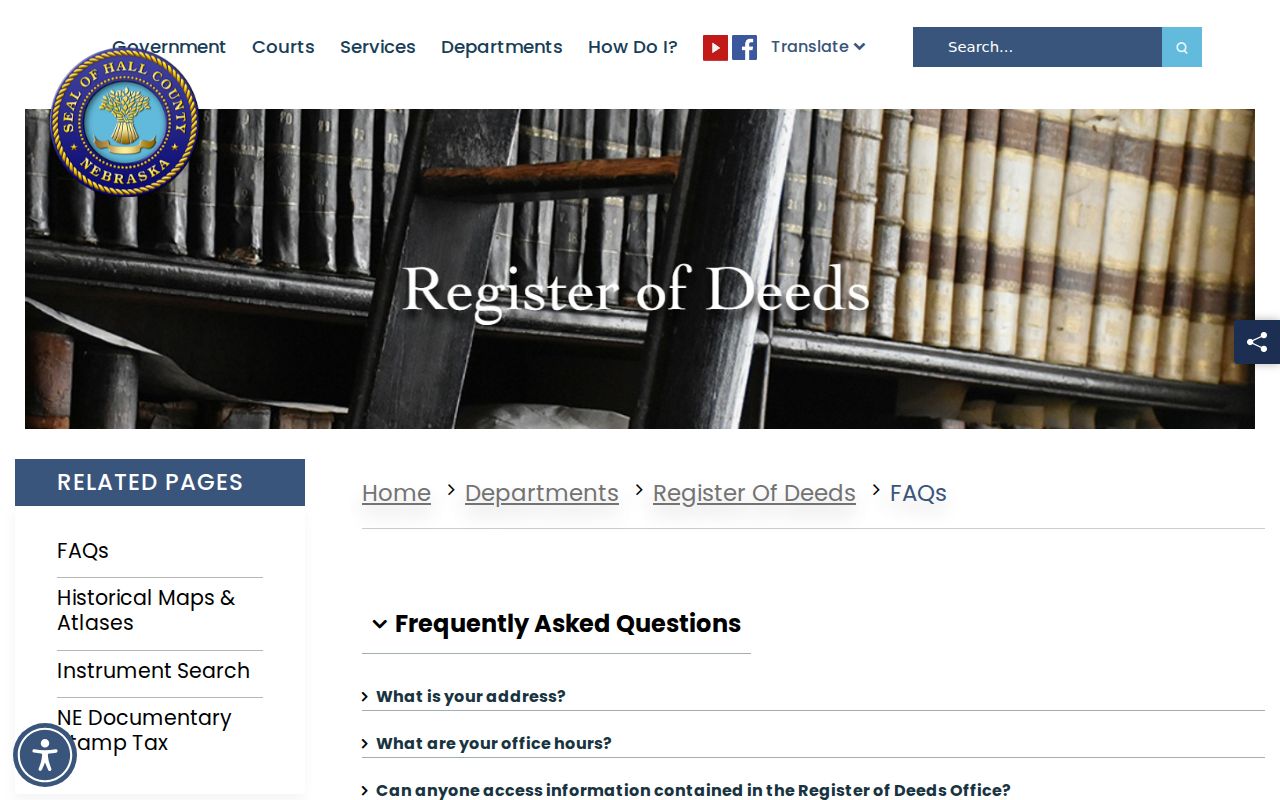
A recorded deed can place parties in a transaction. It does not by itself show every person who occupied the Grand Island address at that date.
Grand Island Parcel Record Checks
Maps keep a backward Grand Island address trail grounded in the physical place. Hall County’s historical maps and atlases include 1885, 1890, and 1904 material. The Library of Congress has a 24-sheet 1909 Grand Island Sanborn set; Hall County also provides a lower-resolution PDF mirror. An atlas can show ownership or plats in its date. A Sanborn sheet can show Grand Island street names, blocks, building footprints, construction notes, and occupancy categories.
Use a map for historical context, not as a modern title source. Start with today’s parcel ID and legal description. Match the lot or block to a dated atlas plate, locate the block on the Sanborn sheet, and preserve the map date and sheet. If the street number does not resolve in current GIS, compare the map, directory lead, council material, and plat instead of assuming a renumbering. No official Grand Island street-renumbering chronology was located.
Grand Island Census Record Trail
For the people who lived at a Grand Island address, the 1950 census is the latest publicly available individual federal schedule. NARA’s Nebraska enumeration-district metadata helps connect Grand Island streets and wards to the correct population schedule. Begin with a known street, approximate house number, surname, and year. Review adjacent lines only as Grand Island historical household context. Individual schedules from 1960 and later remain restricted under the same federal release framework.
The NARA metadata screen below is the assigned census source for this address-history trail. It is a routing tool for an enumeration district, not a directory of present residents.
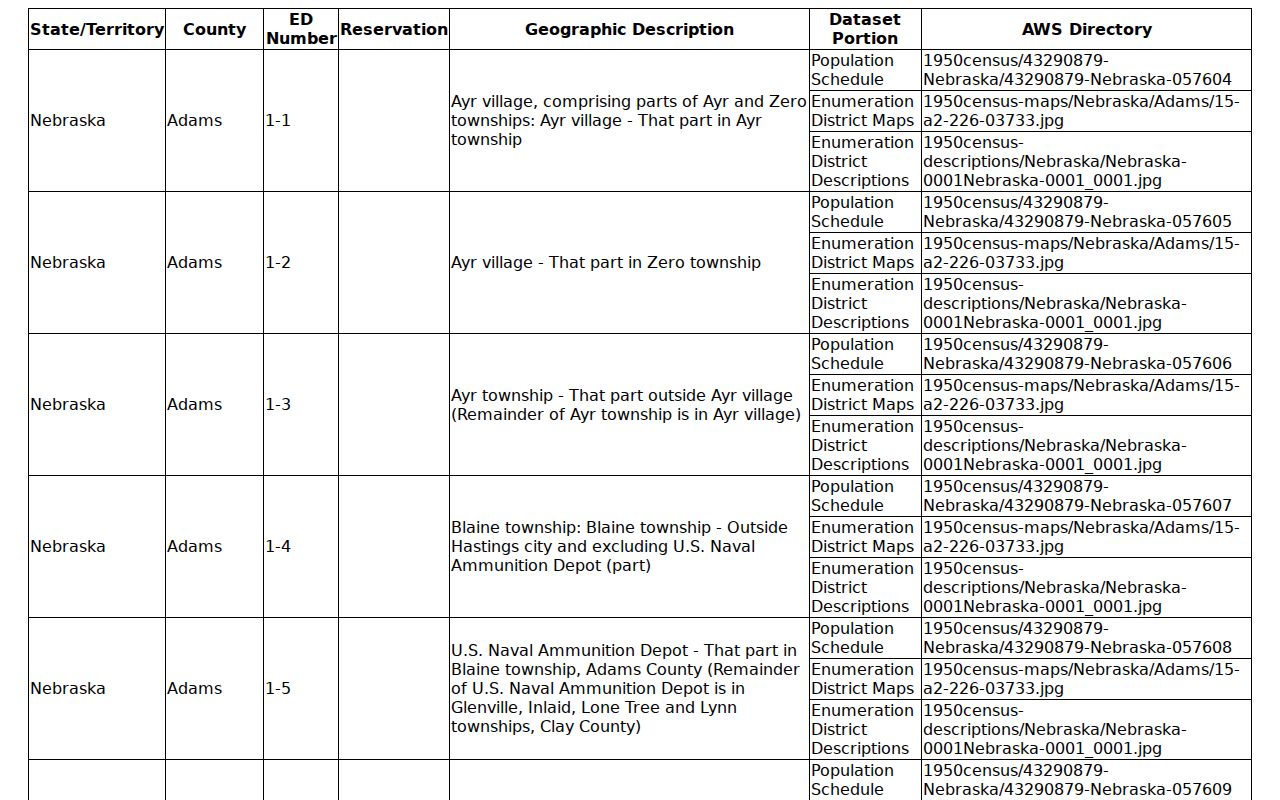
Use the census result with its year, district, street, and line context. A household recorded in 1950 should not be described as a current Grand Island connection.
Pairing sources works in a simple order: current parcel and legal description → recorded deed and instrument date → dated atlas or Sanborn sheet → census enumeration district and household → directory or newspaper record. A source disagreement may mean that dates differ, not that one source is automatically wrong.
Grand Island Directory Household Trail
A deed chain follows transfers. It does not tell the full story of who lived at a Grand Island address. The Grand Island Heritage Room’s local-history materials, microfilm, newspapers, and genealogy resources are the local route for that household layer. Exact directory runs, criss-cross years, and an official house-history guide were not located, so confirm each volume by title and year. The collection details belong with the Grand Island city directories; use them here as dated evidence in a single-address trail.
- Choose the year to test and find the closest confirmed directory volume or census schedule.
- Copy the household name, spelling, address, volume title, year, and page exactly as printed.
- Compare the next available directory or newspaper year, noting any missing years in the collection.
- Use the 1950 census and its enumeration district to anchor the household at a dated point.
- Check an obituary, cemetery entry, probate record, or newspaper notice only as a dated lead, then verify with its custodian where needed.
The Hall County Newspaper Digitization Project is the strongest free local newspaper lead. Search a person’s name with initials, married-name variants, and a likely title or year. The project’s title list and About material describe some coverage differently, so cite the scanned issue instead of claiming a continuous run from the catalog alone.
Note: A name disappearing from a directory may reflect a move, death, unlisted status, a spelling change, or a missing volume.
Grand Island Permit Records
Grand Island permit and city records can add improvements, project descriptions, or a date range to a house history, but no public address-search permit portal was located. Route a focused request to the office that keeps the existing record. Hall County Building Inspection is at 2807 W 2nd St, Grand Island, NE 68803, phone (308) 385-5293. Its form uses project address, owner name, contractor details, construction classification, project value, work description, signature, and date, which are useful terms to include in a written request.
The City Clerk is another route for council proceedings, ordinances, resolutions, contracts, conditional-use permits, and deeds. The office is at City Hall, 100 E 1st St, Grand Island, and its published phone is (308) 385-5444 ext. 1111. State the department, record type, address or parcel, date span, and whether inspection or electronic copies are wanted. The Nebraska Public Records Act asks agencies for existing records; it does not require a new house-history analysis.
The City Clerk page below is the assigned public route for civic records connected to a Grand Island address.
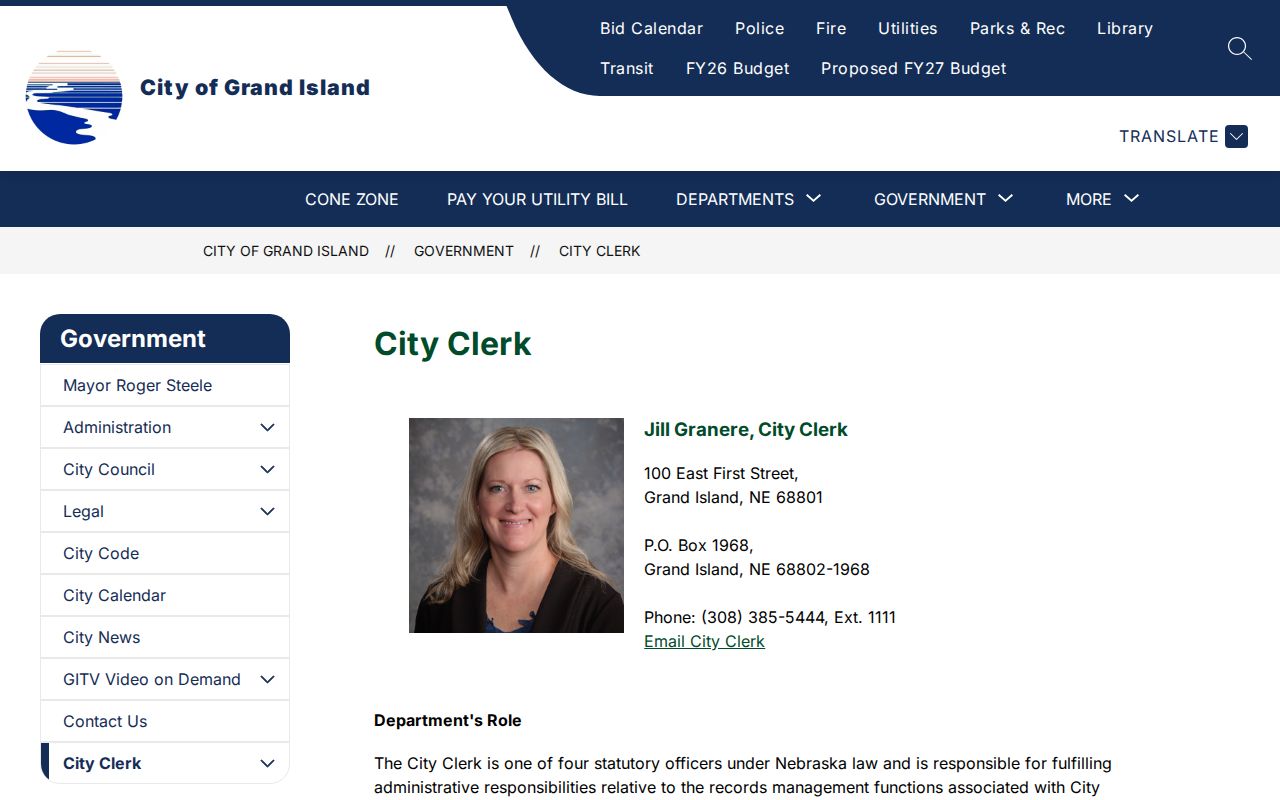
The image points to the appropriate city custodian. It does not imply that every permit or deed is searchable online by street address.
Grand Island Past-Resident Boundaries
Past residents research is appropriate for house history, family history, estate or heir questions, and personal curiosity. It should not be used to locate, track, or harass a living person. Nebraska’s Address Confidentiality Program can protect an eligible participant’s actual address through a substitute mailing address. Public records also carry record-specific privacy limits, redactions, and use rules. Keep sensitive identifiers out of research notes and treat a public hit as a source to verify, not a reason to publish more detail.
For an unavailable record, ask the Register of Deeds, Assessor, Building Inspection, City Clerk, Heritage Room, or History Nebraska for the specific existing series. A defensible note lists the source URL, custodian, record date, access date, search terms, and what could not be verified. That preserves a usable house history without turning a dated record into a claim about a living person.