
Grand Island City Directory Shelves
Grand Island does not have a verified, official web list of every directory year or a single digitized run. That gap matters. The strongest local starting point is the Grand Island Public Library Heritage Room, whose in-library collections include local history, genealogy, microfilm, newspapers, special collections, and digital databases. The Nebraska State Genealogical Society catalog has a lead for Grand Island City Directory 1993, call number 978.2410 GRA, and a supplemental index points to a 1912 directory. Those are leads to confirm by exact title and year, not proof of an uninterrupted collection.
| Research collection | Known dates | Where to check | Access route |
|---|---|---|---|
| Grand Island directory leads | 1912 lead; 1993 catalog entry | Heritage Room, NSGS, and FamilySearch catalog | Confirm title and year with the holding institution |
| Federal population schedule | 1950 is the latest public individual census | NARA and library research tools | Free federal search and in-library assistance |
| Hall County newspaper project | 1873–2020 across listed titles | Digitized archive and Heritage Room microfilm | Online search, then issue-level verification |
| Historic maps and atlases | 1885, 1890, 1904, and 1909 | Hall County and Library of Congress | Online map scans and local research materials |
For a Grand Island city directory question, begin with the library shelf and catalog rather than treating a search-engine result as a complete collection. The Grand Island Heritage Room does not loan its materials. A staff member, catalog record, or volume title can settle whether a particular year is present, on microfilm, or available through a linked database.
Note: Exact complete Grand Island directory runs and a local official digitization landing page were not located in the research.
Grand Island Heritage Room Research
The Heritage Room is the practical first stop when an old name or address needs local context. It is at 1124 W 2nd St, Grand Island, NE 68801, and its phone is (308) 385-5333. The posted hours inspected for the collection were Monday and Tuesday, 9 a.m. to 8 p.m.; Wednesday and Thursday, 9 a.m. to 6 p.m.; Friday and Saturday, 9 a.m. to 5 p.m.; and Sunday, 1 p.m. to 5 p.m. Verify hours before a visit. Three microfilm readers and volunteer obituary lookup help add routes that an online catalog cannot replace.
Grand Island Heritage Room
Library local-history collection
1124 W 2nd St
Grand Island, NE 68801
(308) 385-5333
Hall County Historical Society
Volunteer history organization
603 N Plum St
Grand Island, NE 68801
(308) 385-1545
The Historical Society has no set public hours outside scheduled programs and events, so advance contact is sensible. History Nebraska is the archival route for Hall County series, while the Heritage Room is better for hands-on local materials. A city directory search often needs both kinds of help: one to identify the volume, another to connect its entry with the county record series.
Grand Island Directory Gaps
A missing Grand Island directory year should remain a documented gap. No official source found a complete city-directory sequence, a web page listing local criss-cross volumes, or a separate Grand Island house-history guide. Do not fill those blanks by assuming that every year was printed, preserved, or digitized. The best fallback is a dated chain: check the Grand Island library by title, then use a census schedule, newspaper issue, map, deed record, or a written request for a local administrative record.
The Hall County RG260 finding aid supplies another bridge. It describes county series from roughly 1859 through 1980, including Register of Deeds records from 1868 to 1974 and assessor records from 1903 to 1980. The online portal is not presumed to reproduce those archival series. Ask for a named record type, an approximate span, a location, and the preferred delivery format.
Decoding Grand Island Directory Entries
City directories commonly organize names and addresses, but their abbreviations and extra fields vary by volume. The research did not verify a uniform Grand Island entry format or a local abbreviation key. Read the front matter of the actual Grand Island volume before treating a letter or mark as an owner, renter, spouse, or occupation signal. A directory is a dated index, not a current identity record and not proof that every person at a Grand Island address appeared in print.
| Name form | Record initials, spelling, and any alternate or married-name form exactly as printed. |
|---|---|
| Street address | Use the house number and street as a date-specific location, then compare it with maps and later records. |
| Occupation or organization | Capture only what the volume prints; definitions and abbreviations belong in that volume’s front matter. |
| Household cue | A spouse, widow notation, or householder wording can be a lead, not a final family conclusion. |
| Address section | When present, a street-order section can help link an address to a printed household entry. |
- Criss-cross directory
- A reverse or street-order section that lists addresses rather than beginning with a person’s name. Its existence and dates must be confirmed for a Grand Island volume.
- Householder index
- An index arranged around the person or household identified for an address. It may omit boarders, children, or other residents.
- Abbreviation key
- The printed explanation, often near the front of a volume, for shortened words and symbols used by that publisher.
Grand Island Newspaper Directory Checks
When a Grand Island directory entry gives only a name and street, the Hall County Newspaper Digitization Project can supply a dated notice, obituary, anniversary item, or business mention. Its interface accepts people, places, and events text, plus a two-term “And” search. Search initials, married names, spelling variants, and a likely date range. For a fast Grand Island check, start with the suspected newspaper title and year instead of sending a broad name search across every title.
Coverage needs care. The archive lists, among others, Grand Island Daily Independent for 1885–1930, Grand Island Independent for 1882–1912, and West Nebraska Register for 1973–1985 and 1987–2020. Its About material describes some overlapping coverage differently. Browse the title and year, then cite the actual scanned masthead, issue date, and page rather than merging conflicting catalog ranges into one claim.
NARA’s 1950 census access is a useful companion when a Grand Island directory date is close to 1950. The census is the latest public individual-level federal schedule under the 72-year release rule. It provides a household snapshot, while the directory can mark an address in another year.
The 1950 census research view below helps identify the correct era and enumeration geography, then points the search back to the volume or issue that supports the address question.
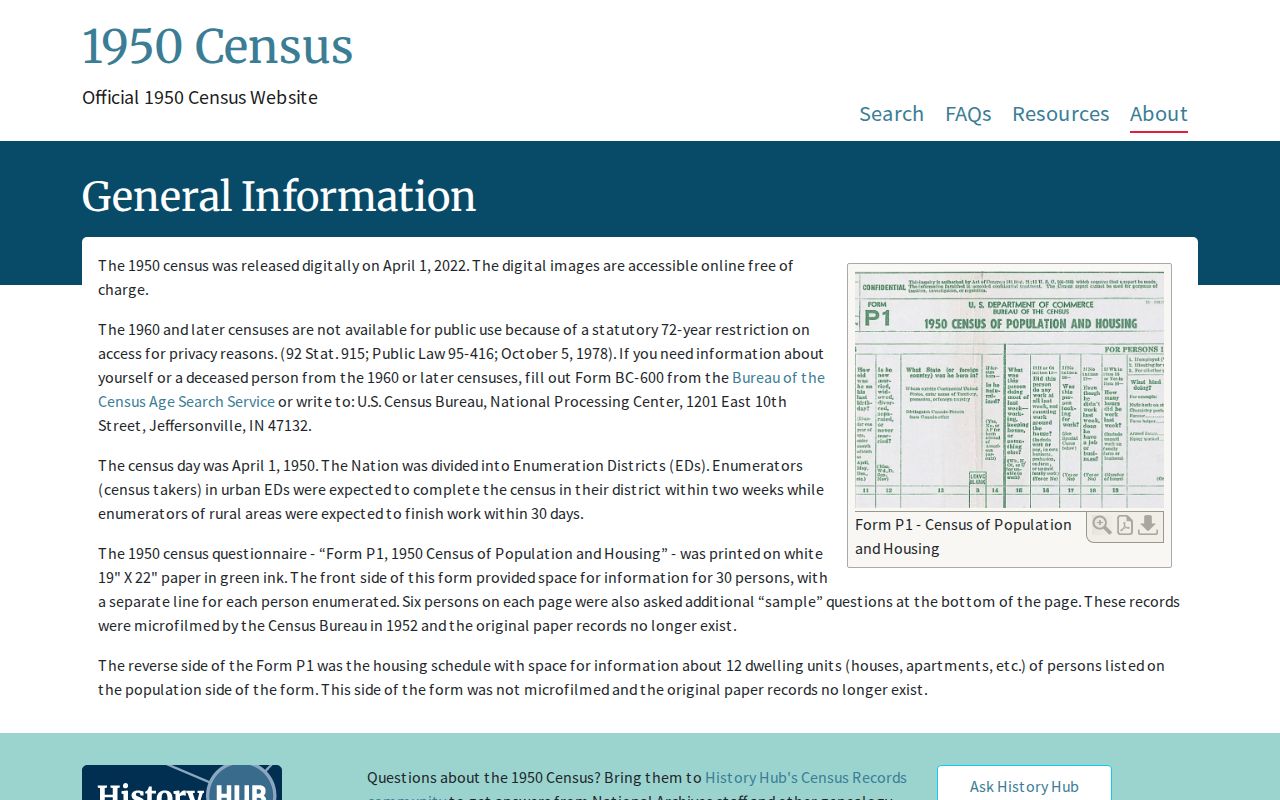
The census image supports the household layer of a directory search. It does not establish a present Grand Island address or replace the original directory citation.
Grand Island Maps and Directories
Historic maps help test whether an address, block, or building label made sense at the time of a directory entry. Hall County makes 1885, 1890, and 1904 atlases available through its historical maps and atlases page. The Library of Congress also holds a 24-sheet 1909 Grand Island Sanborn map set. These sources can show streets, blocks, building footprints, construction notes, and historic context.
Map labels are not title proof and a Sanborn sheet is not a modern ownership record. Match a map date and plate to the city directory year, then compare the printed address with the map’s street pattern. If an old address fails in today’s GIS, check a directory, Sanborn sheet, council material, and plat together. No official local street-renumbering chronology was located.
Trace Grand Island Directory Households
Use one directory entry as a dated starting point. Copy the name spelling, street, occupation wording, title, year, and page. Then search nearby available years for the same household, but do not assume that a name disappearing means a move or death. The person could be unlisted, recorded differently, or outside a missing run. For a current parcel question, use the Grand Island by-street directory route instead of forcing a historical volume to answer a current ownership question.
- Confirm the exact directory title and year with the Heritage Room, NSGS, FamilySearch catalog, or another holding institution.
- Record the full printed entry and the abbreviation key before drawing conclusions from short forms.
- Check the same address and name in nearby available directory years, noting gaps rather than inventing a continuous run.
- Pair a relevant 1950 address with NARA’s Nebraska enumeration-district descriptions and the census schedule.
- Use a newspaper issue, obituary, cemetery record, or archival series to test a move, death, or property change.
For a historic address, the strongest sequence is a city directory entry, census household, map sheet or atlas plate, newspaper issue, and dated county record. A directory gives a useful annual slice. The surrounding sources tell whether the place, household, and record dates line up.
Note: A historical directory entry can document an address in its publication period but cannot prove any present connection to that address.
Grand Island Directory Trail Limits
Keep the source boundaries visible. The Heritage Room, historical society, newspaper archive, NARA, and county offices are different kinds of custodians. A library catalog lead is not the original volume. A community index is not a government record. A current GIS owner string, a deed grantee, and a newspaper mention may all refer to different dates or different people. Record the source URL, access date, record type, and what the source did not show.
For a missing item, use the lawful fallback chain: ask the library to check its holdings, contact the historical society for a scheduled research inquiry, request the relevant Hall County series from History Nebraska, or submit a focused public-record request to the office that keeps the existing record. Nebraska’s Public Records Act, Neb. Rev. Stat. §§84-712 through 84-712.09, does not require an agency to create a new index or answer a research question in a new format.